The People Are out of Touch Pokémon Champions
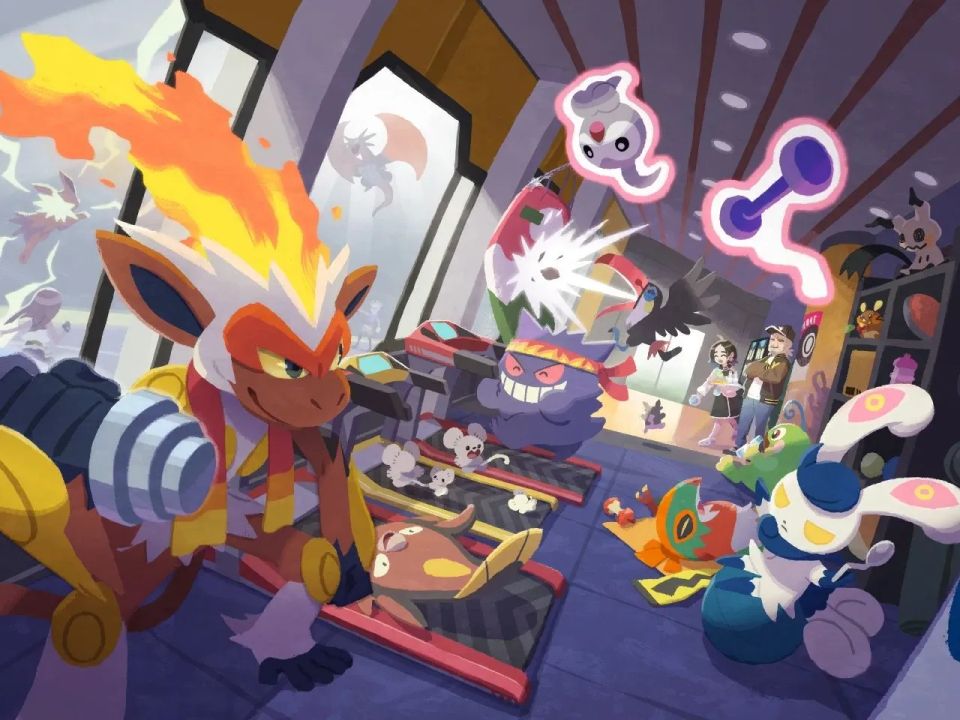
Initially, I was going to try to write a week-in-review of Pokémon Champions. The plan was pretty much exactly what it sounds like. The game’s been out for a little over a week, and I was going to take my time to put my thoughts and feelings out on how this game has taken one of my favorite aspects of Pokémon and brought it to the forefront in the most accessible way it’s ever been. Luckily, I’ve been a busy fella, and it gave me an excuse to pump this essay out in response to some criticisms that I’ve staunchly (and quietly, as I try not to spend a lot of time online) opposed.
The official IGN review of Pokémon Champions, in my opinion, is out of touch with what the game is truly meant to be. Now, I can’t speak for Scott White and his overall experience with the franchise – if the guy’s written for such a number of big publications, I can only assume that he’s got the pedigree to be doing so at what’s pretty much the modern day’s most referenced game review site. That said, I do think that the criticisms he makes for the most part miss the mark on what makes Champions what it is.
Champions is not a game built for the average Pokémon fan. Champions sits in a league of its own, designed to be an engine for official competitive play with a low barrier of entry. I believe that when White voices his criticisms, they aren’t coming from a perspective that’s in tune with this particular sect of the franchise and thus tackles them in a fairly inapplicable way.
I’d like to do some housekeeping before I go any further:
- IGN’s 6/10 rating is not a failing grade. This is not school. You can look at the rating system on its website at the end of every review. A 6/10 means that the game is good, but it’s got a few more caveats to consider before playing than anything with a higher score.
- I’ve been playing Pokémon competitively for over a decade. My first tournament was the Georgia Regionals in 2013. I’m 25 now, and I’ve paid attention to VGC (Video Game Championship, the official competitive format) ever since. Even if I wasn’t actively building teams and going to events, I was watching tournaments and talking to my friends about the game, and I’ve always understood the general complexities of VGC.
- I mean this to all be a good faith argument against a criticism from a voice much larger than mine. If at any point it feels like that’s not the case, go ahead and hang me out to dry. Moving on…
To start, I’d like to say that I agree with a handful of White’s criticisms. The lack of single-player content is something that surprised me, given that games like Pokémon Stadium and Pokémon Colosseum include ways for players to battle CPUs. While the approach in those games was different due to the time period and what was technologically possible, there being no single-player battles or offline mode was a big letdown. I’d also agree with the visual elements being lopsided and weak. White mentions how “Hyper Beam vaporizes the opponent like a scene out of Dragon Ball Z, but Body Slam sees the user simply rise up and come back down, flattening their opponent while remaining in an idle animation.” And yeah, he’s absolutely right. Given that the roster of this game is so much smaller than any mainline entry, the fact that move animations still fall into so few categories for each Pokémon is upsetting when the game is 100% focused on battling without having to worry about any story progression or minigames. Pokémon made the big shift to 3D over a decade ago, and one of the most consistent complaints since then has been the fact that the 3D models look static and boring. Other games since then have taken some pretty large leaps in terms of making their creatures feel more alive – Dragon Quest Monsters: The Dark Prince and Digimon Story: Time Stranger come to mind.
For instance, let's look Delphox. In the official artwork, it’s this really interesting, witchy Pokémon, with ear tufts that stick out in a way that feels like it’s meant to intimidate whatever it’s aiming its wand at, and that lean in that it’s doing really emphasizes a battle-ready attitude.
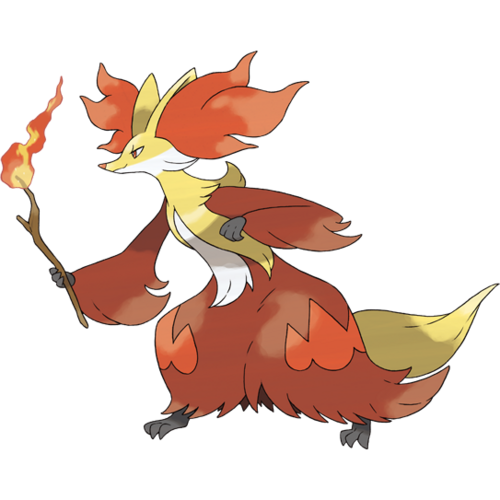
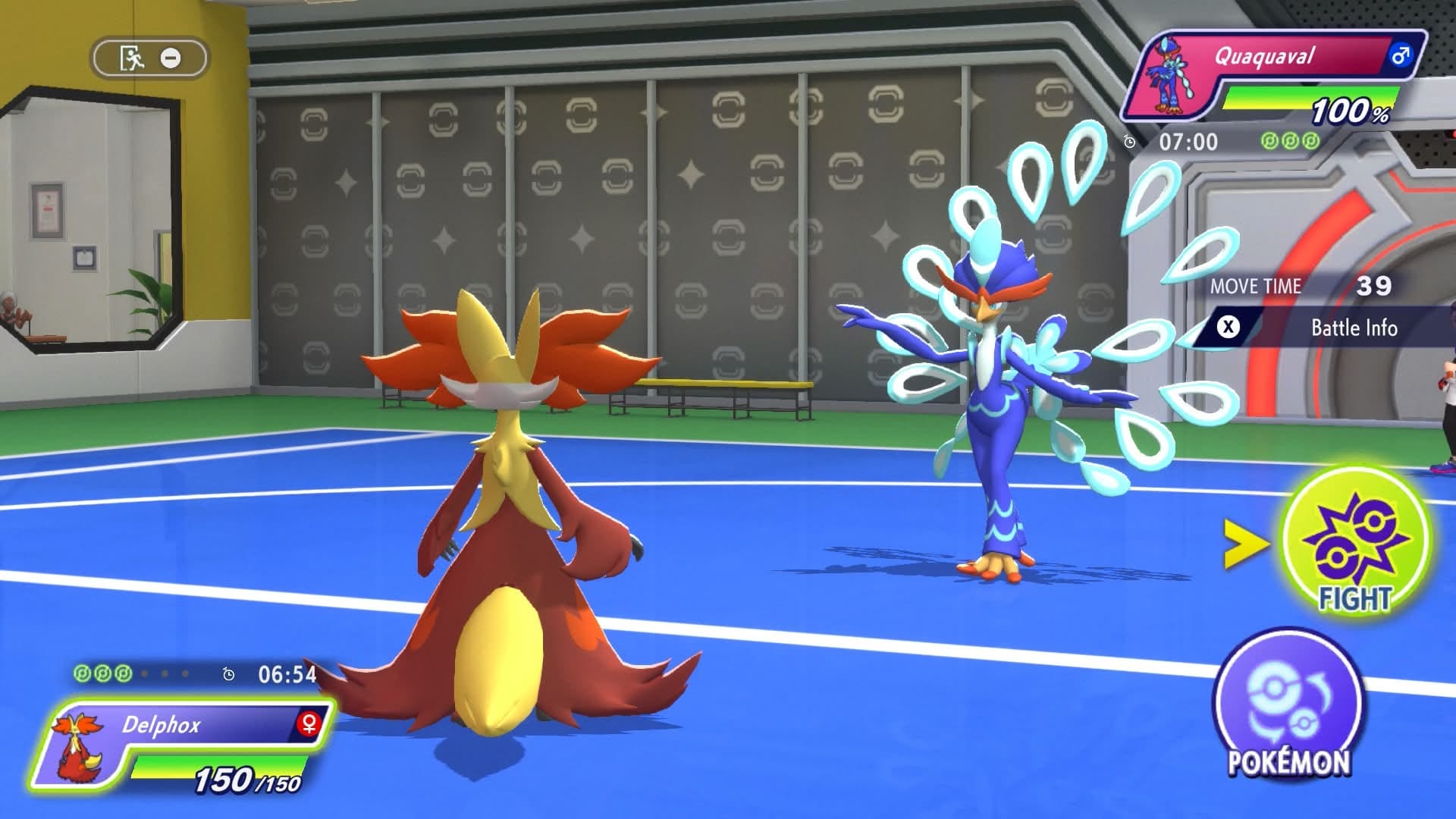
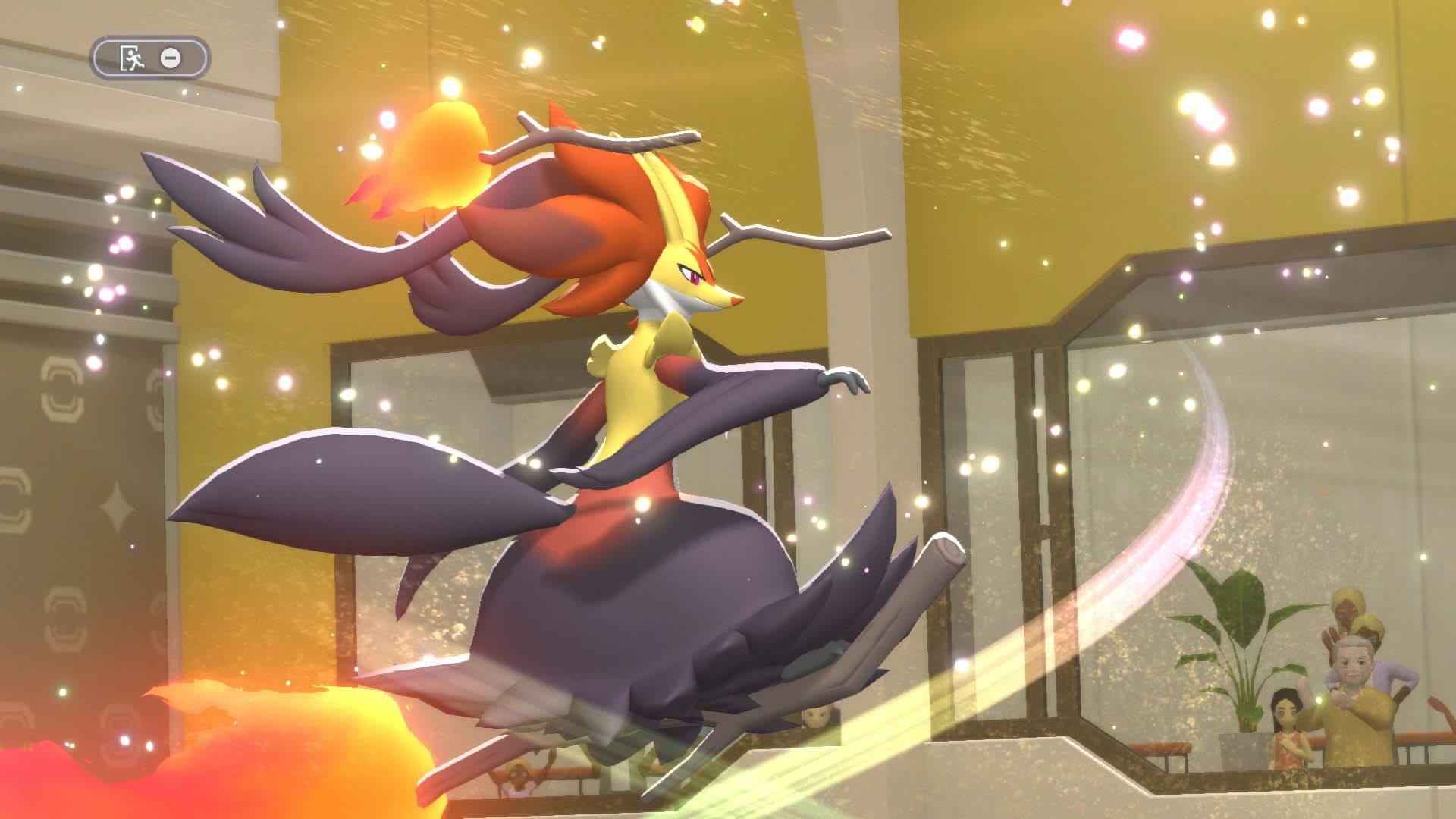
If we look at Delphox in the actual game, just…stands there. Occasionally, it’ll pull out its wand for an idle animation, but other than that it just stands there until it uses a move. It’s boring and doesn’t invoke the same bravery and intrigue that the artwork does. I will give credit where it’s due, though, as its mega evolution looks cool enough in both its pose and design. But why do we need to have them just standing there when they can be depicted doing something so much more thematically appropriate?

A last little note, but White refers to the game as “turn-based nostalgia fuel.” I didn’t really get that, but I will say that being able to bring in some of my guys for competitive play has given me the urge to boot up older games in hopes of giving them more ribbons and fun titles that aren’t accessible without doing so. Maybe that’s what he was hitting at, or maybe he just means that Pokémon has been around for forever and this feels like Colosseum and Stadium to him.
Alright, now onto the stuff that I’m here to contest.
Pretty early on in the review, White has this to say concerning the roster of legal Pokémon in Champions.
"In fact, basically all early evolutions are absent, and baffling omissions like Rillaboom, Mewtwo, Mew, or most of the other Legendaries leave glaring holes in the roster. We can expect some gaps to get filled in over time with live service updates, of course, but how fast and to what extent is still a mystery, and what’s available right now leaves me feeling like Psyduck – confused and with a headache."
For the record, there are currently 186 Pokémon available in Champions that are legal for the current format, and able to be transferred into the game through Pokémon HOME or obtained in the little gacha game that you can play once a day for free. If we look at this in the grand scheme of things, it can feel like a low number. Pokémon Sword and Shield, and Scarlet and Violet both had closer to 400 Pokémon available for use in their first official formats. This, however, included not-fully-evolved Pokémon, many of which simply don’t see use in competitive play. Beyond this, of the Pokémon White mentions in this quote, Rillaboom is the only omission that was genuinely a surprise, as it’s been a competitive staple ever since it gained its hidden ability during Sword and Shield. Mewtwo and Mew are legendary and mythical Pokémon respectively that exist legally within their own rulesets. Beyond this, Mew is only legal in rulesets that have zero competitive bearing, ones that pop up when a game is near the end of its competitive lifespan, or during a game’s off-season when there are no major events being held. To me, citing these roster omissions as "glaring holes" shows a lack of prior knowledge about what competitive formats in VGC are about. Rotating formats that add or remove Pokémon from tournament legal play have been a thing ever since the seventh generation with Pokémon Ultra Sun and Ultra Moon.
I would argue that the roster of Champions feels extremely curated more than anything. It contains a broad mixture of the more popular monsters you’ll probably see on merchandise like water bottles and journals, the first partner Pokémon from almost every generation, competitive staples, and Pokémon with particularly niche uses that can draw a player’s attention to see how they can make it work in a competitive format. Part of the fun I’ve witnessed new players have with the game is trying to make funny moves like Round work on a team and then winning with just one or two moves.


The list of currently legal Pokémon in Champions' Rules Regulation M-A.
White doesn't mention how a handful of moves and abilities have been balanced and had their numbers raised or decreased compared to their most recent appearances. Take for example Unseen Fist, an ability that allowed a Pokémon’s moves to always hit, even through Protect – a move that’s made to block all incoming damage in a turn – to deal full damage. Champions has nerfed this ability, reducing the incoming damage through Protect down to 25% of what it would normally do. This is huge!
Moving further past the roster of Pokémon, White also criticizes the items available in the game.
"The unique goodies that you can have your team hold are nearly as uninspired, with a vast majority either being healing berries or items that improve certain move types (not including the Mega Evolution stones), with outliers such as the Scope Lens, Light Ball, Mental Herb, and Shell Bell being the saving graces. Heavy hitters like the Power Herb, Choice Specs, Air Balloon, and many others used by the most hardcore players are all absent, which could make Champions a tough berry to swallow at the moment."
Similarly to my statement about the roster, I think that the limited items have forced more creativity in team building. If you look online, the game is full of greenhorns that are having a hard time keeping up with the fact that they just have so much learning to do. Every battle is a knowledge check. That's what competitive Pokémon is. Even the luck of critical hits or chances to inflict statuses on your opponents is something to play around. If you look at any forum post where someone new is commenting on the game, the biggest questions come from them just…not knowing what other players do.
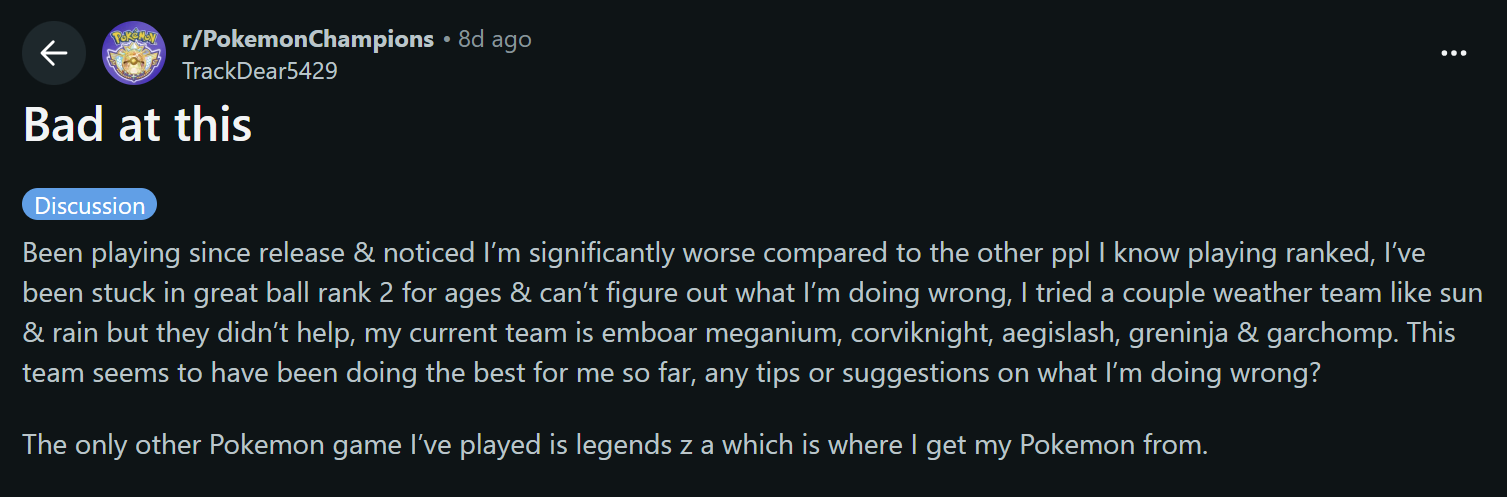
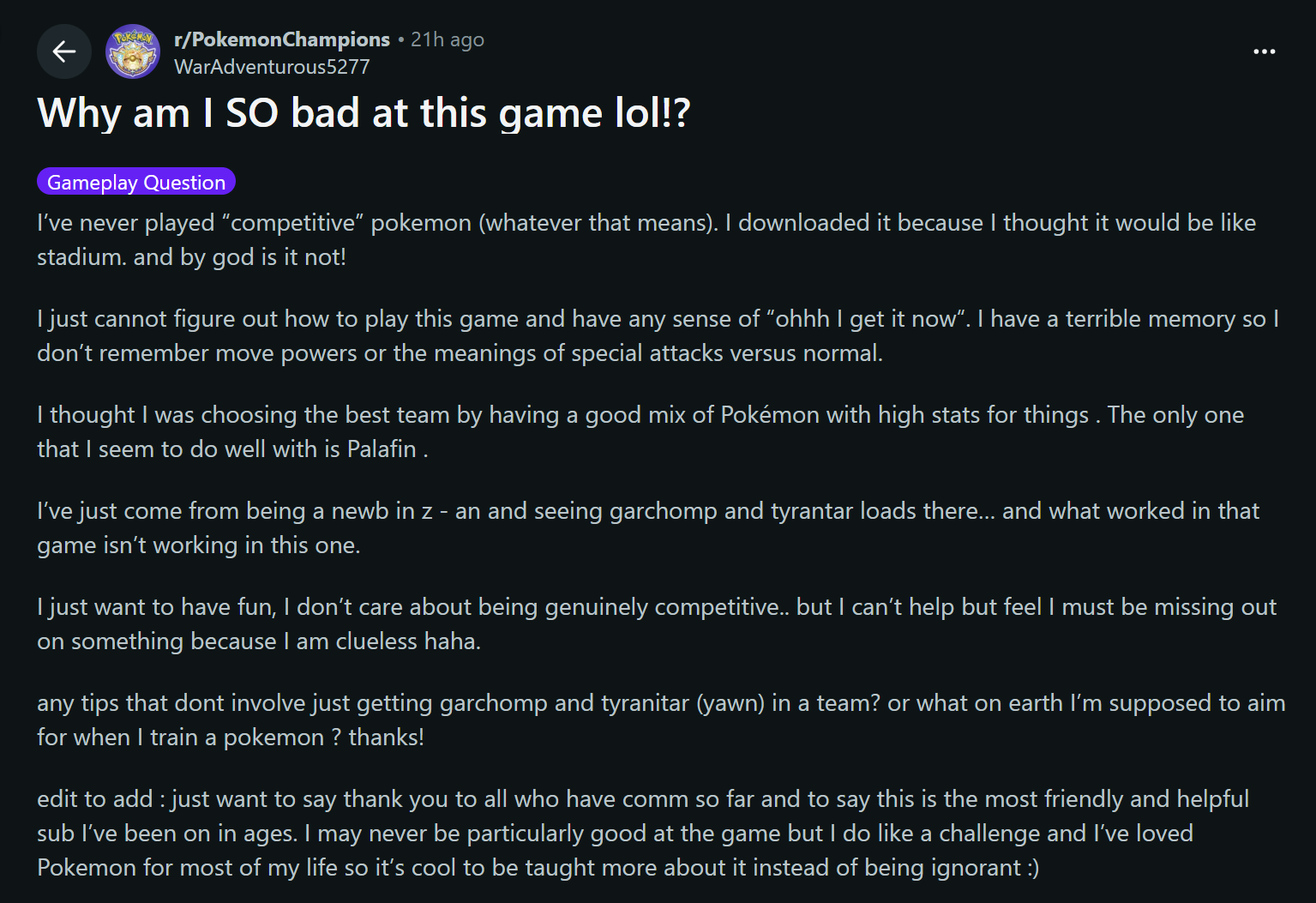
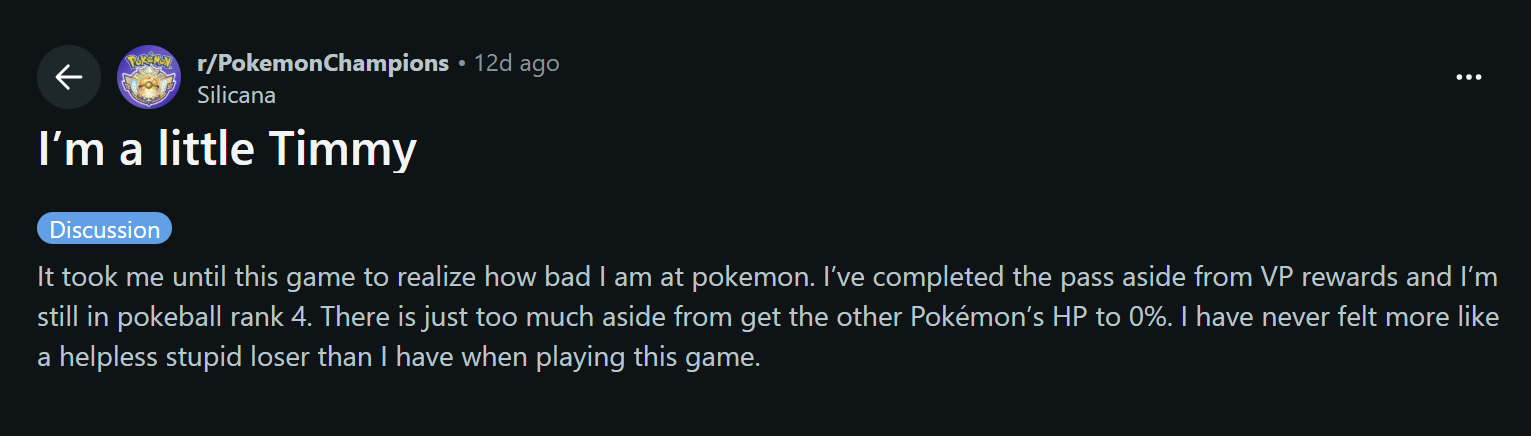
A collection of screenshots from r/PokemonChampions
I would argue that the items that are in the game are still pretty solid, chosen to omit bloat and prevent an already complex game from being even more overwhelming for new players. I can’t imagine being a rookie who wants to play the free-to-play battling game and trying to understand what the Covert Cloak is, or why having Safety Goggles would matter, or why I would want to risk using the Life Orb if it means I’m going to lose health every time I attack. Sure, these are the growing pains of a competitive game, but curating the item feed in a way that will realistically expand as time goes on makes sense to give veterans a chance to be more creative and flexible with their teams without entirely relying on staple item choices, as well as letting new players get a solid grasp on the game, and get their bearings for the challenges to come.
Before the rating verdict, White points out that adjusting a Pokémon's stats requires spending Victory Points (VP), the in-game currency you get from completing missions and playing on the ranked ladder. He says that requiring you to pay VP to change moves, stats, and abilities "does blemish it somewhat," and I personally think this is an empty complaint. VP is extremely easy to earn, as is completing the battle pass, which nets you a boatload of VP. You get VP even for losing. The only time managing it can feel a tad annoying is when you want to make a heavy change to a Pokémon you want to use, and upon realizing you need to earn more you think "damn, I gotta play a little more and get my bread up."
The review ends with a 6/10 verdict, an "OK" from IGN. It's a good game with a few blemishes here and there, and I can generally agree with that. That said, I don't personally think that every caveat mentioned by White stands to be the reason that Champions is just ok at the moment. I wouldn’t try to push this game onto a new player unless they expressed a direct interest in competitive Pokémon, and even the people that I’ve spoken to in that field just ask why not play Pokémon Showdown!, a web-based battle simulator, instead. Where White sees Champions as an uninspired deluge of content that still manages to be fun, I see it as a solid way to introduce players to the official competitive format.
And hey, if I haven’t convinced you, maybe a world champion can.
Hi. I do this all for the love of the game, but if you liked this or any of my other work, hit the little orange button and I'll pop up in your inbox whenever I publish another essay. It's free, but you can give me money if you really feel like it.


Comments ()